
Supporting your body's stress response starts with an honest picture of what's actually going on, since most endocrinologists don't recognize "adrenal fatigue" as a formal diagnosis, but the exhaustion, wired-at-night feeling, and afternoon crashes that get blamed on it are completely real. This guide pulls together everything we've covered on the topic, what the research actually says, the real signs to watch for, how your thyroid fits in, the daily habits that matter most, and how to think about supplements, including our own, honestly.
In this guide
- The reality check: what "adrenal support" means (and doesn't)
- Signs your stress response may be running high
- How your adrenals and thyroid interact
- The daily habits that matter most
- Choosing an adrenal support supplement
- Why we use nine herbs instead of one
- How to take Adrenal Edge
- FAQ
The reality check: what "adrenal support" means (and doesn't)
Endocrinologists at Cedars-Sinai and Cleveland Clinic are on record saying adrenal glands don't simply "run out" of cortisol from stress the way the term adrenal fatigue implies. That doesn't make your symptoms less real, it means the label doesn't point to the actual cause, which is usually a mix of disrupted sleep, thyroid changes, blood sugar swings, or unmanaged stress. We go through the full research, doctor quotes, and what to do instead in Is Adrenal Fatigue Real?
Signs your stress response may be running high
Rather than framing everyday exhaustion as "high cortisol," a rare and specifically diagnosable condition, it's more accurate to talk about your stress response and recovery falling out of rhythm. Common signs include feeling tired but wired at night, afternoon energy crashes, salt or sugar cravings, brain fog, a shorter temper than usual, and getting sick more often. None of these alone are alarming, but together they're worth paying attention to. The full list, plus a quick-reference table of what each sign usually points to, is in 11 Signs Your Stress Response Is Running High.

How your adrenals and thyroid interact
This part is genuine, documented physiology, not a wellness talking point. Elevated cortisol can slow the conversion of thyroid hormone T4 into its active form T3, shunt more of it toward an inactive form called reverse T3, and suppress the pituitary signal that tells your thyroid to work. It runs both directions too: an underactive thyroid can push cortisol higher as your body compensates. That's why fatigue, weight changes, and brain fog are so often hard to untangle without bloodwork. The full breakdown, with citations, is in The Adrenal-Thyroid Connection.
The daily habits that matter most
Whatever the underlying cause turns out to be, a small set of daily basics helps almost everyone: a consistent sleep and wake schedule, steady meals instead of long gaps followed by sugar, regular movement, and a real outlet for stress rather than pushing through it. These aren't glamorous, but they're the foundation everything else sits on. We cover all seven in detail, with specific tips for each, in 7 Habits for the Wired-and-Tired.
Choosing an adrenal support supplement
If you're shopping for a supplement, format and transparency matter more than marketing claims. Liquid tinctures absorb faster than capsules and let you adjust your dose by the drop. Watch for guarantee length (ours is 90 days, longer than most competitors), and know that most products, liquid or capsule, list their herbs as a combined blend rather than individual milligram amounts, that's standard for the category, not a red flag specific to any one brand. We compare five of the most-searched options, including Cortisol Manager and Cortisol Calm, in our full comparison guide.
| If you want to... | Read this next |
|---|---|
| Understand whether "adrenal fatigue" is real | Is Adrenal Fatigue Real? |
| Check your own symptoms against real signs | 11 Signs Your Stress Response Is Running High |
| Understand the thyroid connection | The Adrenal-Thyroid Connection |
| Build better daily habits first | 7 Habits for the Wired-and-Tired |
| Compare adrenal supplements on the market | Best Adrenal Support Supplement Comparison |
| Understand why Adrenal Edge combines nine herbs | Why Adrenal Edge Combines Nine Herbs Instead of One |
| Learn dosage and timing for Adrenal Edge | How to Take Adrenal Edge for Best Results |
Why we use nine herbs instead of one
Adrenal Edge combines nine herbs because the stress response touches energy, focus, calm, and immune resilience all at once, and each herb is traditionally used for a different piece of that picture rather than repeating the same job. That said, a single, well-studied ingredient like KSM-66 ashwagandha has more individual clinical research behind it than any blended formula, including ours, and gives you an exact, disclosed dose, something a combined herb blend can't claim. Neither approach is automatically the right answer. The full breakdown of that trade-off, stated plainly, is in Why Adrenal Edge Combines Nine Herbs Instead of One.
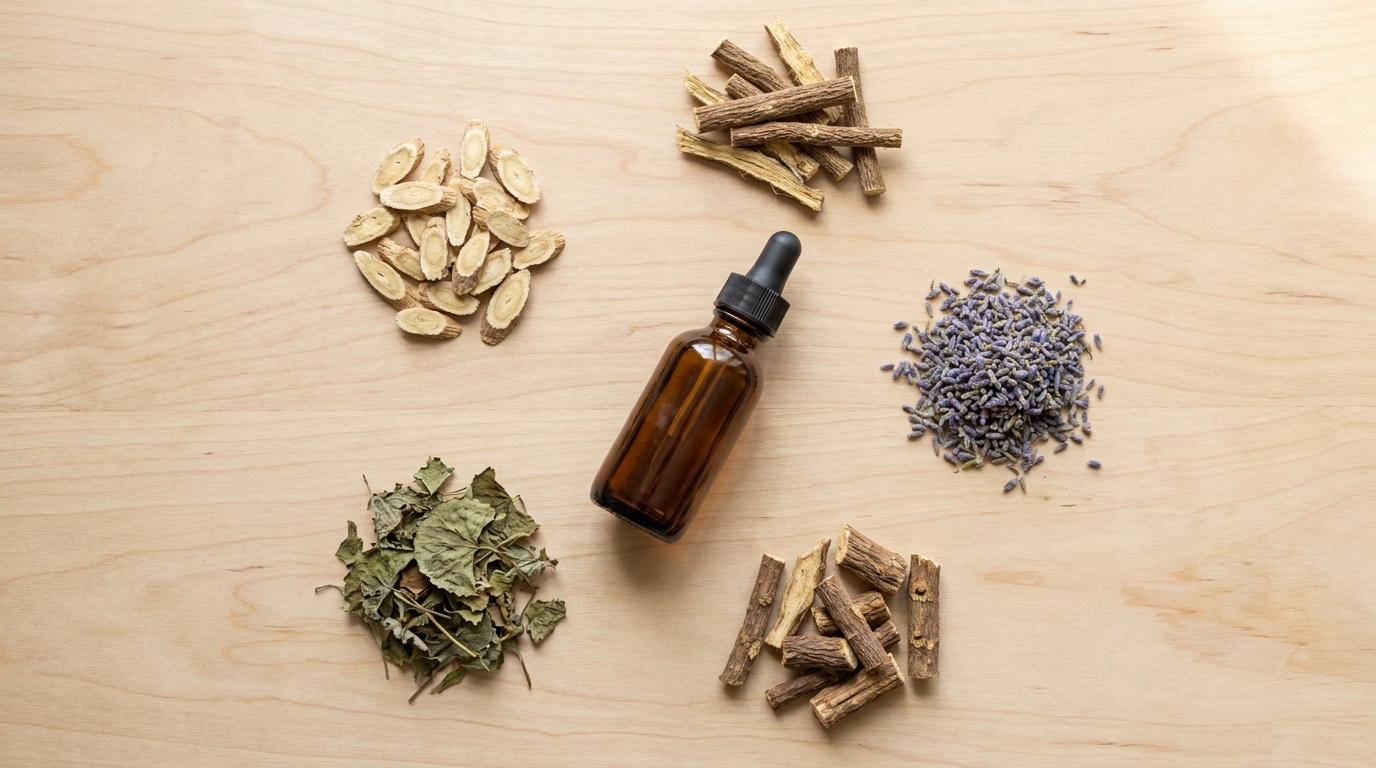

A liquid blend traditionally used to support the body's everyday response to stress.
How to take Adrenal Edge
The standard dose is 1/4 teaspoon (25 to 30 drops), one to three times a day, shaken well and taken directly or mixed into water or juice. It's meant to be used consistently over several weeks alongside the daily basics above, not as a one-time fix. Full dosing guidance, a step-by-step routine, and common mistakes to avoid are in How to Take Adrenal Edge for Best Results.
Frequently asked questions
Is "adrenal fatigue" a real medical condition?
Most endocrinologists say no, it's not a formal diagnosis, though the underlying symptoms (fatigue, stress, poor sleep) are real and usually have a more specific explanation worth investigating with your doctor.
How are my adrenals and thyroid connected?
Elevated cortisol can measurably affect how your body converts and uses thyroid hormone, and the relationship runs both directions. Persistent symptoms deserve real bloodwork rather than a guess.
What should I try first, lifestyle changes or a supplement?
Lifestyle basics (sleep, meals, movement, stress management) are the foundation. A supplement can be a reasonable addition alongside those basics, not a replacement for them.
Do I need a multi-herb blend or is ashwagandha alone enough?
It depends on whether you have one specific concern (ashwagandha alone, with more research behind that single ingredient) or several overlapping symptoms (a broader blend, with less per-ingredient research transparency).
Start with the basics, add support where it helps
Nine traditional herbs, one easy liquid dose, backed by a 90-day guarantee.
Shop Adrenal Edge →90-day money-back guarantee. Free shipping on orders over $70. Not intended to diagnose, treat, cure, or prevent any disease.