
Adrenal Edge combines nine herbs because your stress response isn't just one thing to support, it touches energy, focus, calm, sleep, and immune resilience all at once, and traditional herbal formulation has long paired ingredients that each cover a different piece of that picture rather than asking a single herb to do everything. Here's the thinking behind that approach, what each herb is traditionally used for, and an honest look at when a single, well-researched herb might actually be the better choice instead.
In this article
- The traditional logic behind herbal blending
- What's in Adrenal Edge, and why
- How this plays out in daily life
- Is more herbs always better?
- When a single herb might be the better choice
- FAQ
The traditional logic behind herbal blending
Herbal traditions across cultures, from Ayurveda to Western herbalism, have long combined herbs with complementary roles rather than relying on one ingredient alone: something for energy, something for calm, something for digestion, something for immune resilience. The idea isn't that more herbs automatically means a stronger effect, it's that different herbs are traditionally suited to different jobs, and combining them can address more of what someone is actually experiencing day to day.
What's in Adrenal Edge, and why
Each of the nine herbs in Adrenal Edge has a specific traditional role rather than repeating the same job as another:
| Herb | Traditional role |
|---|---|
| Astragalus | Immune system support |
| Eleuthero root | Stamina and resilience during demanding stretches |
| Ginkgo leaf | Circulation and mental clarity |
| Gotu kola leaf | Skin and circulatory support |
| Licorice root | Digestive and adrenal comfort |
| Lavender flower | Calm and relaxation |
| Passionflower leaf | Reducing everyday nervous tension |
| Wood betony herb | Soothing the nervous system |
| Spearmint leaf | Digestive support |
How this plays out in daily life
In practice, that traditional division of labor is meant to cover the shape of an ordinary demanding day rather than any single moment. Eleuthero root's traditional use for stamina lines up with mornings that ask a lot of you. Ginkgo leaf's traditional role in mental clarity fits the afternoon stretch where focus tends to slip. Lavender and passionflower's traditional calming use matters more in the evening, when winding down is the goal. Astragalus, licorice root, and spearmint sit underneath all of it, traditionally used to support immune resilience and digestive comfort no matter what time of day it is. None of that is a guarantee of how any one person will feel, it's simply the reasoning behind combining these particular nine rather than choosing one and stopping there.
Is more herbs always better?
Honestly, no, and it's worth saying plainly. Some adaptogen researchers caution that simpler combinations of two to three herbs, each present at a meaningful amount, can outperform very broad blends where the logic becomes "more ingredients equals better" rather than matching the right herb to the right job. Ashwagandha in particular, especially the well-studied KSM-66 extract, has been evaluated in 24 human clinical trials on its own, more individual research than any blended formula, including ours, can claim.
To be direct about our own product: Adrenal Edge lists its nine herbs as a combined blend total, not an individual milligram amount per herb. That's standard for liquid tinctures generally, not unique to us, but it does mean we can't claim each herb sits at a specific clinically studied dose. We'd rather say that plainly than imply otherwise.

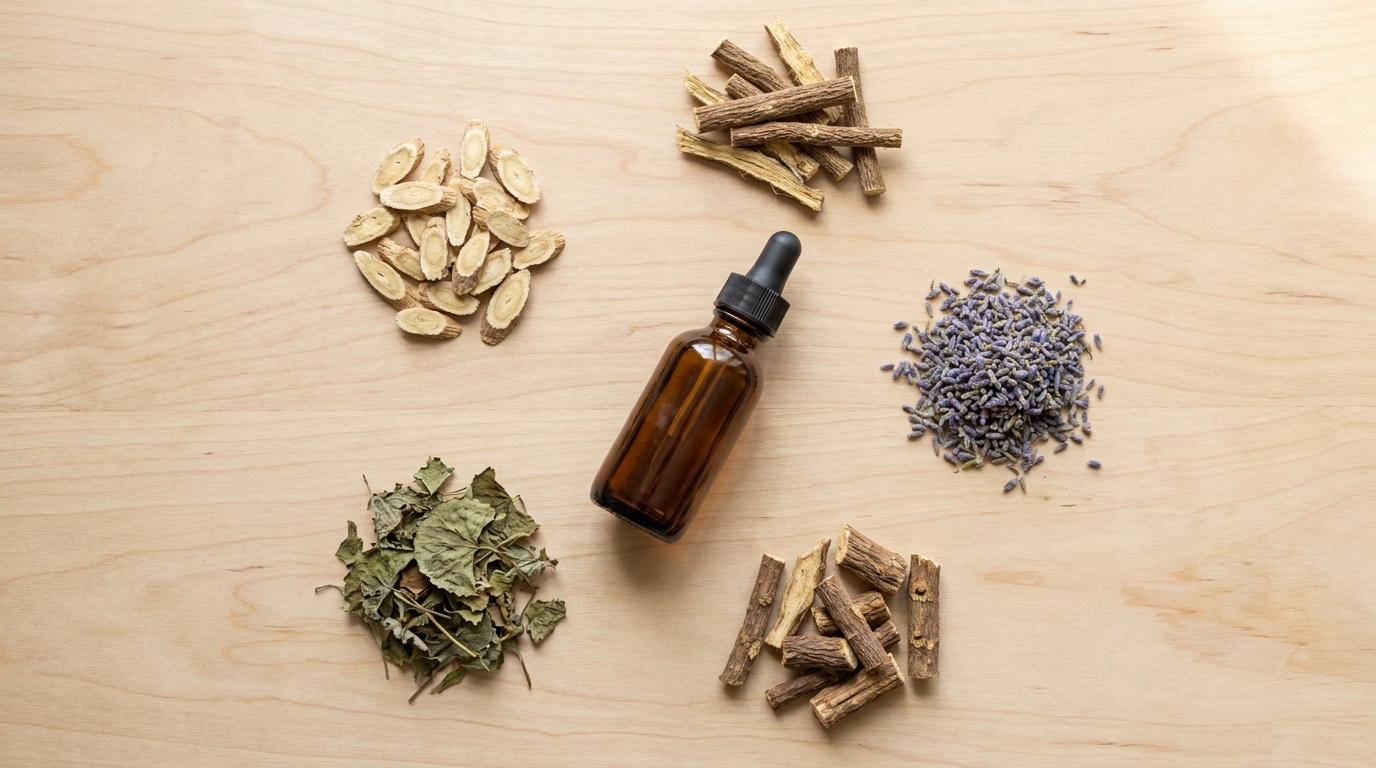
Nine traditional herbs in a liquid dose, each chosen for a different role.
When a single herb might be the better choice
If you have one specific, well-defined concern and want the ingredient with the deepest individual research behind it, plus an exact, disclosed dose on the label, a standardized single-ingredient product (ashwagandha being the most common example) is a reasonable choice. If you're dealing with several overlapping symptoms and would rather take one product than stack three or four single-ingredient bottles, that's where a thoughtfully combined blend like Adrenal Edge tends to make more practical sense, with the dosing caveat above in mind.
Frequently asked questions
Why does Adrenal Edge have nine herbs instead of one or two?
Each herb is traditionally used for a different piece of the stress response, energy, calm, immune support, and digestion, rather than repeating the same function. The goal is broader coverage in one product, not simply "more is better."
Is a bigger blend always more effective than a single herb?
Not necessarily. Some formulation experts favor simpler combinations of two to three well-dosed herbs over very broad blends. A single, well-studied ingredient can also have deeper individual clinical research behind it than any blended formula.
Does Adrenal Edge disclose how much of each herb is in the blend?
It lists the nine herbs as a combined blend total, which is standard for liquid tinctures, rather than an individual milligram amount for each one.
Should I take a multi-herb blend or a single ingredient like ashwagandha?
It depends on your situation. One specific, well-defined concern is often well served by a single, well-researched herb. Multiple overlapping symptoms may be better served by a broader traditional blend.
Nine herbs, each with a job to do
One easy liquid dose, backed by a 90-day guarantee.
Shop Adrenal Edge →90-day money-back guarantee. Free shipping on orders over $70. Not intended to diagnose, treat, cure, or prevent any disease.